
Thank you! We'll be in touch within 24 business hours with your free estimate.
Concrete Driveways | Concrete Commandos Austin
Heavy-duty residential and commercial driveway installation across Travis County — engineered for Texas clay soils, limestone caliche sub-layers, and decades of load-bearing performance.
Licensed & Insured | Travis County Specialists | Free Estimates
Get Your Free Driveway Quote
How We Engineer Every Driveway for Austin's Ground Conditions
Austin's expansive black-clay soils and limestone caliche sub-layers make subgrade preparation the most consequential phase of any driveway installation. Shortcuts taken here translate directly into premature cracking, heaving, and structural failure within three to five years. Our process eliminates those failure modes at every stage.
Site Excavation & Grade Preparation
We begin with full-depth site excavation — typically 6 to 10 inches below finish grade — removing all organic material, unstable fill, and root mass. Grade is established using transit-level surveys to ensure positive drainage away from the structure at a minimum 2% slope, preventing the pooling that accelerates sub-slab erosion in Austin's high-intensity rainfall events.
Subgrade Compaction to 95% Proctor Density
Once excavated, the subgrade is moisture-conditioned and mechanically compacted to a minimum 95% Proctor density using vibratory plate compactors and jumping jack rammers for confined edges. This compaction standard, verified by nuclear density gauge testing on commercial pours, eliminates differential settlement under repeated vehicle loads — critical when Texas clay swells and contracts seasonally with rainfall cycles.
Vapor Barrier Placement
A 10-mil polyethylene vapor barrier is installed over the compacted subgrade prior to reinforcement placement. In Austin's climate, ground moisture migration through a slab without a barrier accelerates carbonation of the paste matrix, weakening the surface layer and promoting delamination and scaling within the first decade.
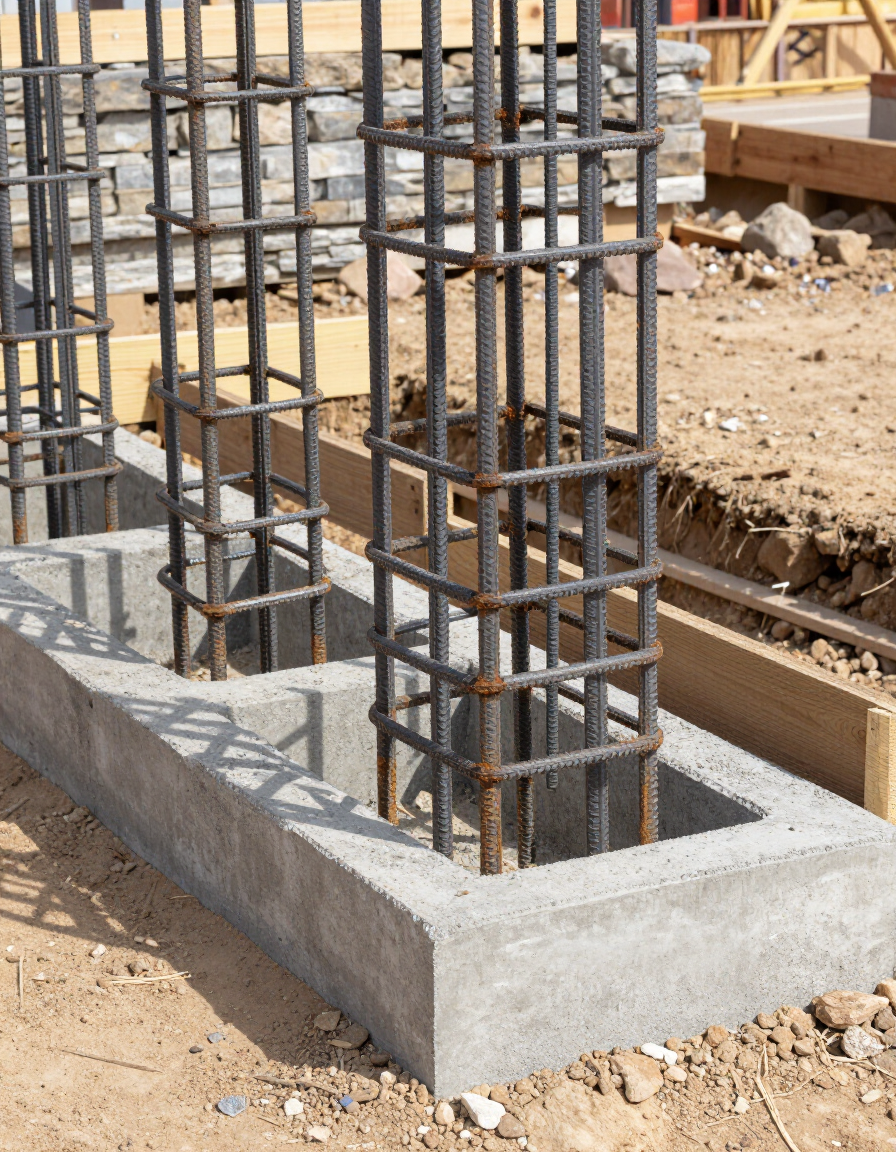
Rebar Reinforcement Matrix Layout
We install a #4 (1/2-inch) deformed steel rebar grid at 18-inch on-center spacing for residential applications and tighten to 12-inch on-center for commercial or heavy-vehicle driveways. Rebar is elevated on 2-inch plastic chairs to maintain proper mid-slab placement, ensuring the steel acts in tension where the slab flexes — not buried against the subgrade where it contributes nothing to structural performance.
Concrete Mix Design & Pour Execution
We specify a minimum 3,500 PSI (28-day compressive strength) air-entrained mix for all residential driveways, with water-to-cement ratios held at or below 0.50 to control shrinkage. Slump testing is performed at the truck chute before any concrete is accepted on-site — we reject loads exceeding a 4-inch slump to prevent over-watering on the pour, which dilutes the cement paste and reduces final compressive strength. Concrete is consolidated with internal vibrators to eliminate honeycombing, and surface finishing is completed using bull floats and power trowels calibrated to the specified broom or exposed aggregate texture.
Why a Properly Engineered Concrete Driveway Outlasts Every Alternative
A concrete driveway is not a commodity product — its 30-to-50-year service life depends entirely on the precision of the pour, the quality of the mix design, and the discipline of the finishing crew. Here is what our process delivers that standard competitors cannot match.
- Freeze-Thaw Resistance: Central Texas endures rapid temperature cycling between freezing nights and 90°F afternoons, particularly in winter. Our air-entrained concrete mix (3–5% air content) creates microscopic void systems within the paste matrix that relieve hydraulic pressure during freeze events, preventing surface spalling and subsurface delamination.
- Decorative Polymer Sealer Options: After a minimum 28-day cure, we apply penetrating silane-siloxane or film-forming polyurethane/epoxy sealers that repel motor oil, hydraulic fluid, and road salt, while offering optional tinted or gloss finishes for enhanced curb appeal without sacrificing functional protection.
- ACI 330-Compliant Expansion Joint Spacing: We score or saw-cut control joints at intervals not exceeding 2.5 times the slab thickness in feet (e.g., 10-foot spacing for a 4-inch slab) per ACI 330 guidelines, directing shrinkage cracking to intentional, concealed locations rather than random surface fractures.
- Heavy Vehicle Load-Bearing Integrity: Residential driveways engineered for RVs, pickup trucks, and boat trailers require a minimum 5-inch slab thickness at 4,000 PSI — our structural calculations account for axle load distribution across Austin's seasonally variable subgrade bearing capacities.
- Long-Term Stain & UV Resistance: Polymer sealers applied at our specification rates block UV degradation of the surface paste and prevent hydrocarbon staining, maintaining a clean, professional appearance across the driveway's full service life.
- Proper Positive Drainage Engineering: Every driveway we install is graded to Austin's drainage standards — minimum 2% cross-slope — to prevent ponding that erodes joint sealant and undermines the subbase in Travis County's heavy storm-cell events.
Every benefit above is a direct product of disciplined installation, not the concrete mix alone. Contact Concrete Commandos Austin for a site evaluation and free driveway estimate across Travis County.
Driveway Technical Specifications
Every driveway we install is engineered to meet or exceed the following structural and material specifications. Residential and commercial applications differ in slab thickness and PSI target — use this table to identify the right specification for your project scope.
| Specification | Residential Driveway | Commercial / Heavy-Vehicle Driveway |
|---|---|---|
| Material Thickness | 4–6 inches | 6–8 inches |
| PSI Strength Rating | 3,000–3,500 PSI | 4,000–4,500 PSI |
| Rebar Specification | #4 @ 18" O.C. | #4–#5 @ 12" O.C. |
| Water-to-Cement Ratio | ≤ 0.50 | ≤ 0.45 |
| Air Entrainment | 3–5% | 3–5% |
| Subgrade Compaction | 95% Proctor Density | 95–98% Proctor Density |
| Average Lifespan | 30–50 years | 25–40 years (with joint maintenance) |
| Typical Curing Time | 28-day full cure / 7-day load-bearing | 28-day full cure / 7-day load-bearing |
| Expansion Joint Spacing | Per ACI 330 (2.5× slab thickness) | Per ACI 330 / Engineer of Record |
| Sealer Recommendation | Silane-siloxane penetrating | Polyurethane or epoxy film-forming |
Specifications are standard baselines. Final mix design and slab thickness are determined during the on-site assessment and may be adjusted based on soil bearing capacity, drainage conditions, and local municipal requirements within Travis County.
Serving Every Corner of Travis County — From Downtown Austin to West Lake Hills
Concrete Commandos Austin operates across all of Travis County, including the full City of Austin and surrounding municipalities. Whether you're upgrading a driveway in the urban core or engineering a heavy-vehicle entrance on a larger residential lot in West Lake Hills, our crews mobilize to your site with the same material standards and installation discipline.
Explore our service coverage by location or return to the full service overview:
Need a quote today? Visit our contact page or call 737-374-7883 during business hours (8AM–6PM, Monday–Friday) to schedule your site evaluation.
Concrete Driveway Service Coverage: Travis County, Texas
Concrete Commandos Austin installs and repairs concrete driveways throughout Travis County and the Greater Austin Area. Our office is located at 4800 Bee Caves Rd Unit 650, Austin, TX 78746 — positioned to provide fast mobilization to residential and commercial driveway projects across the county. Call 737-374-7883 to confirm scheduling availability for your address.
Driveway Installation FAQs: Austin & Travis County
These are the most common technical questions we receive from homeowners and property managers in Travis County before committing to a concrete driveway installation or replacement.
How much weight can a concrete driveway support — will it handle my RV, truck, or boat trailer?
A 4-inch residential concrete driveway at 3,500 PSI is engineered to support passenger vehicles and light trucks in the 5,000–10,000 lb range. For RVs, heavy-duty pickup trucks with towed loads, or boat trailers exceeding 10,000 lbs GVW, we specify a minimum 5-inch slab at 4,000 PSI with a tightened rebar grid at 12-inch on-center spacing. Load distribution is also a function of subgrade bearing capacity — on Austin's expansive clay soils, a properly compacted and stabilized subbase is equally critical to preventing punching failure under concentrated tire loads. We assess your specific vehicle load requirements during the site evaluation at no charge.
What is the minimum slab thickness required for Austin's black-clay subgrade, and why does it matter?
Austin's expansive black-clay (Vertisol) soils undergo significant volumetric change — swelling during wet seasons and shrinking during the drought periods Central Texas experiences annually. On unstable clay subgrades without proper stabilization, a 4-inch slab can develop differential settlement cracks within two to three years. We address this by excavating to stable bearing material, moisture-conditioning and mechanically compacting the subgrade to 95% Proctor density, and where soil conditions require it, applying a lime-stabilization treatment to chemically modify the clay and reduce its plasticity index. Minimum slab thickness over treated clay subgrades in Austin is 4 inches for light residential and 6 inches for heavy-vehicle or commercial applications.
How do you verify subgrade compaction before the pour, and what happens if it doesn't pass?
On commercial driveway installations, subgrade compaction is verified using a nuclear moisture-density gauge, which provides immediate field readings of dry density and moisture content referenced against the lab-determined Proctor curve. On residential pours, we use a plate compactor with pass-count documentation and a hand penetrometer for field confirmation. If any zone of the subgrade fails to meet the 95% Proctor density threshold, we re-compact and retest before formwork is set. No concrete is poured over unverified subgrade — that single discipline is what separates a 30-year driveway from a 5-year repair cycle.
Do I need a permit for a concrete driveway replacement or new installation in Austin or Travis County?
In the City of Austin, a driveway permit is required for any new driveway construction or modifications that alter the curb cut, change impervious cover calculations, or connect to a public right-of-way. Permit applications are filed through Austin's Development Services Department and typically process within 5–10 business days for standard residential projects. In unincorporated Travis County areas, permit requirements vary by jurisdiction — some ETJ (Extraterritorial Jurisdiction) zones require only a Land Disturbance or Impervious Cover permit. Concrete Commandos Austin manages the permit application process on your behalf as part of our project scope — you do not need to navigate the municipal system independently.
Ready to Install a Driveway Built to Last 50 Years?
Concrete Commandos Austin is ready to assess your site, specify the correct slab thickness and PSI rating for your soil conditions, and deliver a written free estimate with no obligation. We serve all of Travis County, including Austin, West Lake Hills, Lakeway, Bee Cave, and Pflugerville.
Call us directly during business hours (8AM–6PM):
Estimates are free and provided within 24 business hours of your inquiry. Licensed, bonded, and insured in Travis County, Texas. Email: estimates@concretecommandos.pro