
Thank you! We'll be in touch within one business day.
Decorative & Stamped Concrete | Concrete Commandos Austin
Custom stamped patterns, UV-resistant color hardener systems, and premium polymer sealer finishes — engineered for Austin-area residential and commercial properties. Serving all of Travis County.
Get a Free Decorative Concrete Quote
How Decorative & Stamped Concrete Is Installed — The Concrete Commandos Process
Decorative concrete is not a surface-applied coating — it is a full structural slab system engineered from the subgrade up. Every Concrete Commandos Austin installation begins with subgrade compaction to a minimum 95% Proctor density, ensuring the base layer resists the vertical load and seasonal heave common in Travis County's expansive clay and fragmented limestone soils.
Once the sub-base is verified, a 4-mil vapor barrier is placed over compacted fill before a welded wire mesh or rebar reinforcement matrix is set to prevent reflective cracking. The concrete mix is specified to a 3,500–4,000 PSI compressive strength with a carefully controlled water-to-cement ratio — kept at or below 0.50 — to maximize density and minimize surface bleed water that would dilute color hardener adhesion.
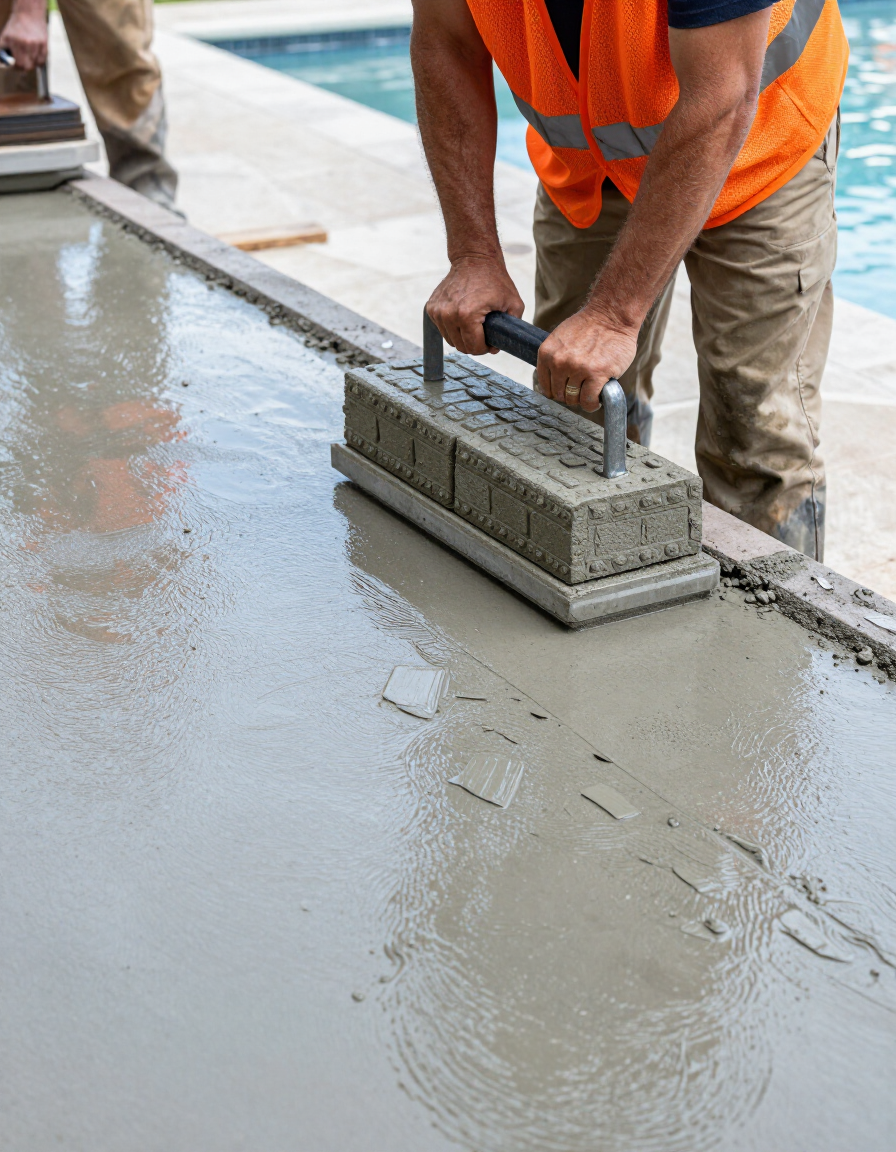
Color is introduced either as integral pigment batched directly into the mix at the plant or as a broadcast color hardener seeded onto the fresh slab surface and floated in. A release agent — either powder or liquid — is applied before stamp presses are set, providing mold release while contributing a second contrasting antiquing tone that defines joint lines and pattern depth. Stamps are pressed systematically in overlapping rows while the concrete is in the workable plastic stage, maintaining consistent impression depth across the entire pour.
Central Texas averages over 220 days of direct sunlight annually, and UV index readings in Austin regularly reach 10–11 during peak summer months. Standard acrylic sealers break down under this exposure within 12–18 months, causing color fade, surface chalking, and loss of slip resistance. Concrete Commandos Austin applies a multi-coat decorative polymer sealer system rated for UV stability — typically a solvent-based or water-based polyurethane-reinforced acrylic — that maintains color vibrancy, repels moisture, and meets ASTM C920 elastomeric performance benchmarks for the Central Texas climate zone.
Stamped Patterns, Color Systems & Texture Finishes Available in Austin
Every decorative concrete project begins with a design consultation. Below is the full library of stamped patterns, color application methods, and surface texture finishes Concrete Commandos Austin deploys across Travis County — from West Lake Hills estate pool decks to Bee Cave commercial courtyards.
Stamped Patterns
• Ashlar Slate — large-format irregular stone blocks; ideal for patios and pool surrounds
• Cobblestone — tight circular units with deep grout lines; European streetscape aesthetic
• Wood Plank — parallel grain-scored boards; popular for covered outdoor living areas
• Flagstone — natural random-cut stone look; pairs well with limestone landscape walls common in West Austin
• Herringbone Brick — interlocking angular units; preferred for driveway apron accents and walkway borders
Color Application Methods
• Integral Color — pigment pre-mixed into the concrete at the batch plant; consistent color through the full depth of the slab
• Broadcast Color Hardener — dry-shake iron oxide compound seeded onto fresh concrete; creates high surface density and vibrant, durable color
• Acid Stain — hydrochloric acid and metallic salt reaction; produces variegated earthy tones (amber, terra cotta, walnut) with permanent bond
• Water-Based Stain — acrylic penetrating stain in an expanded palette including charcoal, slate blue, and sage; zero VOC; ideal for indoor or enclosed patios
• Antiquing Release Agent — powder or liquid secondary color applied over hardener before stamping; defines pattern depth and joint lines
Surface Texture Finishes
• Stamped Texture — high-relief pattern surface from rubber mat presses; primary decorative method for patios, driveways, and pool decks
• Exposed Aggregate — surface paste removed by water wash or retarder to reveal embedded stone aggregate; naturally slip-resistant
• Broom Finish — linear texture dragged across fresh surface; economical, slip safe, standard for sidewalks and utility flatwork
• Smooth Trowel — dense, polished surface achieved through steel troweling; used for interior slabs or sheltered covered patio areas
• Salt Finish — rock salt embedded and removed after cure; produces subtle pitting that adds grip without aggressive texture
Decorative Concrete Technical Specifications
The following specifications represent Concrete Commandos Austin's standard engineering parameters for decorative and stamped concrete installations in Travis County. These values account for Central Texas's thermal expansion cycles, peak summer heat (regularly exceeding 105°F), and soil bearing capacity variability across the Austin metropolitan area.
| Specification | Standard Value | Notes |
|---|---|---|
| Material Thickness | 3.5–5 inches | 4 inches standard residential; 5 inches for driveways and commercial flatwork |
| PSI Compressive Strength | 3,500–4,000 PSI | Higher PSI reduces surface permeability and improves color hardener adhesion |
| Water-to-Cement Ratio | ≤ 0.50 | Critical for minimizing bleed water that dilutes surface color |
| Rebar / Reinforcement | #3 or #4 rebar at 16" O.C. | Wire mesh acceptable for non-vehicular flatwork |
| Subgrade Compaction | 95% Proctor Density minimum | Required to prevent differential settlement in Texas clay soils |
| Color Hardener Coverage | 60–80 lbs per 100 sq ft | Seeded in two passes for uniform color saturation |
| Sealer Coat System | 2–3 coats polymer acrylic | UV-stabilized; solvent- or water-based per exposure condition |
| Average Lifespan | 20–35 years | Dependent on resealing every 2–4 years |
| Curing Time — Foot Traffic | 24–48 hours | Do not apply sealer until surface moisture has fully dissipated |
| Curing Time — Vehicle Traffic | 7 days minimum | Thermal cure conditions accelerate in Austin summer heat; monitor surface temperature |
Decorative Concrete Across Travis County's Most Demanding Neighborhoods
Stamped and decorative concrete is in high demand across high-end Travis County communities. Concrete Commandos Austin delivers the same precision installation standards — from subgrade compaction through final polymer sealer coat — whether the project is a West Lake Hills estate courtyard or a Bee Cave commercial development. Explore our local service pages to understand how regional soil conditions, HOA guidelines, and municipal zoning rules shape every decorative pour we execute.
Decorative Concrete in West Lake Hills
Hillside estates in West Lake Hills demand decorative concrete that accounts for local limestone substrate, HOA aesthetic guidelines, and steep-grade drainage — all factors Concrete Commandos Austin engineers into every stamped pour.
Decorative Concrete in Bee Cave
Bee Cave's rapid commercial and residential growth — including developments near the Hill Country Galleria — creates consistent demand for stamped driveways, pool decks, and commercial courtyard flatwork that meets both aesthetic standards and aquifer-protection zoning requirements.
Decorative & Stamped Concrete Service Area — Travis County, Texas
Concrete Commandos Austin provides decorative and stamped concrete installation across all of Travis County, including Austin, West Lake Hills, Lakeway, Bee Cave, and Pflugerville. Our crew mobilizes from our office at 4800 Bee Caves Rd Unit 650, Austin, TX 78746, giving us fast response times across the entire county service footprint. Call 737-374-7883 or submit the quote form above to confirm scheduling availability in your neighborhood.
Frequently Asked Questions — Decorative & Stamped Concrete in Austin
These are the questions Travis County property owners ask most before committing to a decorative concrete project. If your question isn't answered here, call Concrete Commandos Austin at 737-374-7883 or submit a quote request — we respond within one business day.
How long will the color in stamped concrete last before it starts fading in Austin's heat?
Color longevity in stamped concrete depends entirely on the sealer system applied, not the color hardener alone. In Central Texas, where UV index values regularly peak at 10–11 and surface temperatures on exposed concrete can reach 160–180°F in July and August, standard acrylic sealers typically fail within 12–18 months — causing chalking, color washout, and loss of pattern definition. Concrete Commandos Austin uses UV-stabilized polymer acrylic sealer systems that carry 3–5 year UV resistance ratings under direct Texas sun exposure. With a proper resealing maintenance schedule, broadcast color hardener and integral pigment systems retain their original vibrancy for 20–35 years. The condition of the sealer, not the color hardener itself, is the primary variable in long-term color performance.How often should I reseal my stamped concrete patio or driveway in Texas?
The standard resealing interval for stamped and decorative concrete in Travis County is every 2–4 years under typical residential use — with the shorter interval applying to surfaces in full sun exposure, high foot traffic areas like pool decks, and driveways subject to vehicle traffic and motor oil contact. The best indicators that resealing is overdue: water no longer beads on the surface (sealer has failed), the color looks chalky or faded, or the surface feels rough and porous rather than smooth and dense. We recommend applying a light maintenance coat before a surface shows visible distress rather than waiting for full sealer failure, which allows moisture and chlorine — from pool splash-out — to begin penetrating the slab matrix.What anti-slip texture options are available for a stamped concrete pool deck in Austin?
Pool deck safety is a non-negotiable specification in any decorative concrete scope. Concrete Commandos Austin offers three primary anti-slip solutions for pool surrounds: (1) Exposed aggregate finish — naturally textured by the surface aggregate profile; the most durable long-term slip resistance option. (2) Shark Grip or aluminum oxide additive broadcast into the final sealer coat — provides measurable COF (Coefficient of Friction) improvement without altering the stamp pattern's visual character. (3) Broom-drag or light sand texture applied over the color hardener before the final sealer coat. For Texas residential pool decks, we typically recommend a stamped pattern with a shark-grip sealer additive — this balances the aesthetic goal of the stamped pattern with the TCNF (Texas Commission on Environmental Quality) and pool code expectations for slip-resistant pool deck surfaces.Can stamped concrete be matched to existing hardscape — pavers, flagstone, or natural stone — already installed on my property?
Yes, and this is one of the primary reasons clients in West Lake Hills, Bee Cave, and Lakeway choose decorative concrete over pavers for patio extensions or driveway additions. Because color hardeners are available in over 30 standard iron oxide pigment formulations and custom blending is possible with acid stain layering, we can achieve a close perceptual match to existing limestone coping, travertine tile, or clay brick hardscape. We conduct an on-site color sample test — a 12-inch poured and stained coupon — prior to full installation to verify color match under the property's specific sun and shade conditions. Exact color replication is not guaranteed due to the reactive chemistry of staining processes, but a perceptually consistent match is achievable in the vast majority of residential contexts.
Ready to Design Your Stamped Concrete Project? Let's Talk.
Concrete Commandos Austin offers complimentary design consultations for decorative and stamped concrete projects across Travis County. Our estimators review your site conditions — subgrade composition, drainage direction, existing hardscape, and sun exposure — before quoting. No pressure, no obligation. Just a precise, honest assessment from a crew that installs to structural specification, not just to aesthetics.
Call us directly or visit our Contact page to submit your project details online. We respond to all quote requests within one business day.
Serving Austin, West Lake Hills, Lakeway, Bee Cave, Pflugerville, and all of Travis County. Office: 4800 Bee Caves Rd Unit 650, Austin, TX 78746. Hours: 8AM–6PM.