
Thank you! We'll be in touch shortly to schedule your free damage assessment.
Concrete Repair & Resurfacing | Concrete Commandos Austin
Austin's expansive clay soils and relentless thermal cycling crack, heave, and spall concrete slabs faster than nearly any other climate in the Southwest. Concrete Commandos Austin delivers structural crack remediation, slab lifting, and polymer overlay resurfacing to restore compromised flatwork across Travis County — without the cost of a full replacement where repair is the smarter structural call.
Get a Free Damage Assessment
How We Diagnose and Repair Damaged Concrete in Austin
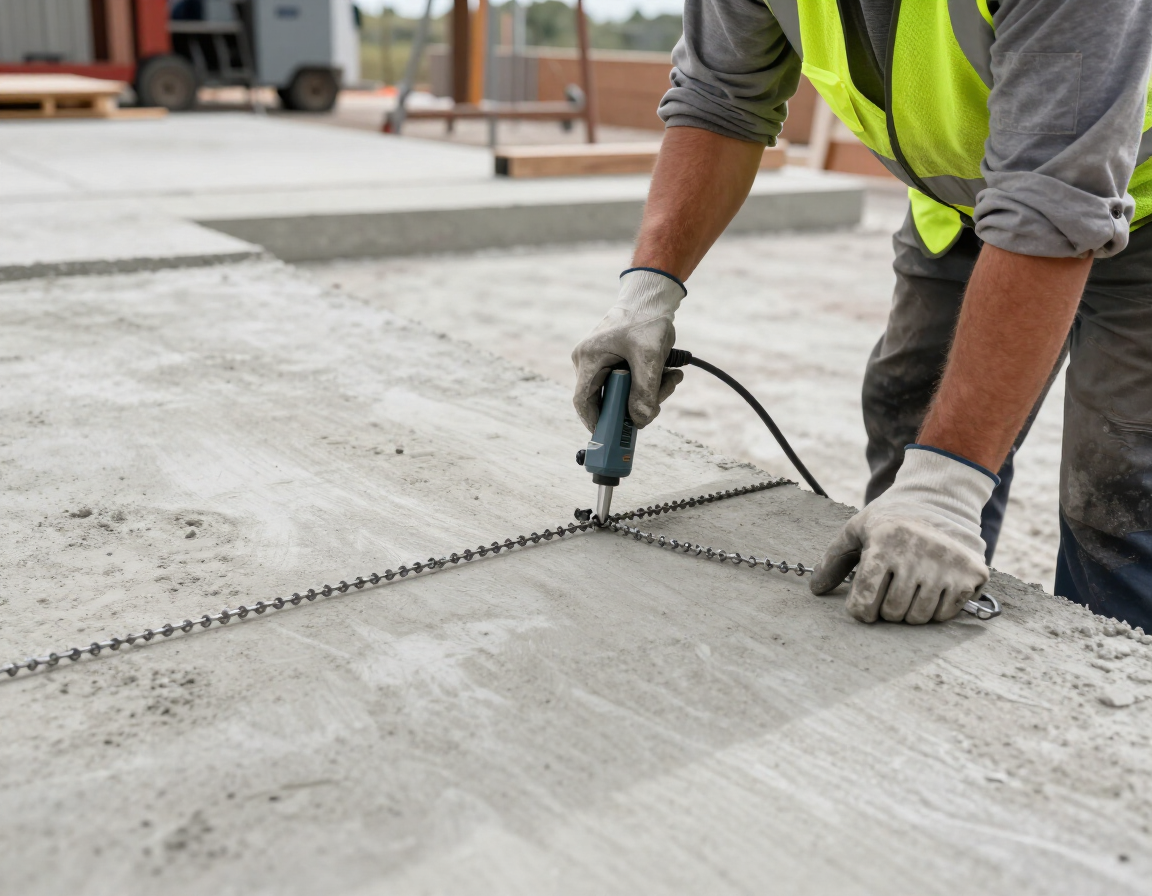
Every repair engagement begins with a systematic on-site diagnostic before a single bag of material opens. Our crew assesses crack morphology — distinguishing between shrinkage hairlines, structural flexural cracks, and heave-induced shear fractures — because the repair pathway is dictated entirely by root cause, not surface appearance.
Subgrade void detection uses chain-drag sounding and, on commercial applications, ground-penetrating radar to map hollow zones beneath settled slabs. The presence, depth, and lateral extent of voids determines whether mudjacking (pressure-injected cementitious slurry) or polyurethane foam lifting (high-density expanding foam injected through 5/8-inch ports) is the appropriate lift method. Polyurethane foam achieves lift in minutes, cures waterproof, and adds negligible weight to the subgrade — making it the preferred choice for Austin's expansive clay subsoils where drainage management is critical.
Structural cracks wider than 1/16 inch receive two-component polyurethane or epoxy injection under controlled pressure to restore monolithic continuity. Crack width, orientation, and whether the slab remains in active movement govern resin selection: flexible polyurethane for live cracks in thermally active environments; rigid epoxy for dormant structural fractures requiring full tensile strength restoration.
Cosmetically compromised surfaces — spalling, surface delamination, aggregate exposure, or contractor-grade finishes that have simply aged out — receive polymer micro-topping or full overlay resurfacing at 1/4 to 3/8 inch nominal depth. Overlay mortars are polymer-modified for bond tensile strength exceeding 400 PSI to existing substrate, mixed to a water-to-cement ratio calibrated for Texas summer ambient temperatures to prevent flash-set.
Our Complete Concrete Repair Service Spectrum
Hairline Crack Sealing
Surface-applied polyurethane sealant routed and sealed into cracks under 1/16 inch wide. Prevents water infiltration that accelerates freeze-thaw and alkali-silica reaction in Austin's intermittent wet seasons.
Structural Crack Injection
Two-component epoxy or polyurethane pressure-injected to restore tensile continuity across flexural and shear fractures. Bond strength exceeds original concrete matrix when properly specified.
Slab Lifting & Leveling
Mudjacking and polyurethane foam lifting to correct differential settlement in residential driveways, sidewalks, and pool decks undermined by Austin's shrink-swell clay subgrade dynamics.
Spall Repair with Polymer-Modified Mortar
Delaminated and spalled surface areas are mechanically prepared to sound concrete, primed, and filled with 6,000 PSI polymer-modified repair mortar to re-establish surface continuity and chloride resistance.
Full-Surface Micro-Overlay Resurfacing
1/4 to 3/8 inch polymer overlay applied to structurally sound but cosmetically degraded slabs. Restores a uniform, durable wearing surface at a fraction of full replacement cost.
Decorative Resurfacing with Color & Texture Matching
Stamped or broom-finished overlays with integral pigments and UV-stable acrylic sealants matched to existing flatwork. Achieves visual continuity across patched and original sections.
Repair & Resurfacing Technical Specifications
The following specifications govern material selection, structural performance thresholds, and project timeline expectations for every repair and resurfacing engagement Concrete Commandos Austin undertakes across Travis County.
| Repair / Resurfacing Type | Material Thickness | PSI / Bond Strength | Average Lifespan | Typical Curing Time |
|---|---|---|---|---|
| Hairline Crack Sealing | Surface-applied sealant | N/A (flexible seal) | 5–10 years | 2–4 hours (foot traffic) |
| Structural Epoxy Crack Injection | Void-fill (crack width) | 6,000+ PSI bond | 20–30+ years | 72 hours full cure |
| Polyurethane Foam Slab Lifting | Injected beneath slab | 40–60 PSI foam density | 10–15 years | 15–30 minutes (immediate light use) |
| Mudjacking (Cementitious Slurry Lift) | Injected beneath slab | 100–150 PSI slurry | 5–10 years | 24–48 hours |
| Polymer-Modified Spall Repair | 1/4 inch to 1/2 inch | 5,000–6,000 PSI | 10–20 years | 4–8 hours (foot traffic) |
| Micro-Overlay Resurfacing | 1/4 inch to 3/8 inch | 4,500–5,500 PSI bond | 10–20 years | 4–24 hours (overlay thickness) |
| Decorative Overlay Resurfacing | 3/8 inch to 1/2 inch | 4,500–5,500 PSI bond | 12–20 years | 24 hours (seal coat 72 hours) |
| Full Slab Replacement | 4 inch to 6 inch | 3,500–4,500 PSI | 30–50 years | 72 hours (vehicle traffic: 7 days) |
Aging Concrete in Established Austin Neighborhoods Needs Expert Assessment
Residential driveways and walkways in established Travis County communities experience some of the most demanding structural stress in the region. In West Lake Hills, hillside topography and limestone-over-clay subgrade transitions accelerate differential settlement in concrete flatwork — making professional slab lifting and crack injection a recurring need rather than a one-time event. In Pflugerville, rapid residential growth means newer subdivisions built on engineered fill are already showing heave and shrinkage cracking as the subgrade stabilizes. Whether you are dealing with a sunken driveway panel, a spalling pool deck surround, or a walkway fractured by mature oak root pressure, Concrete Commandos Austin delivers the diagnostic precision and repair chemistry to extend your existing slab's service life by decades. Return to our homepage to explore the full scope of concrete services we provide across Travis County.
Concrete Repair & Resurfacing Service Coverage — Travis County, Texas
Concrete Commandos Austin dispatches repair and resurfacing crews throughout Travis County and the Greater Austin Area. From hairline crack sealing in central Austin residential neighborhoods to commercial spall repair and slab leveling in outlying districts, our response radius covers the full county. Call 737-374-7883 between 8AM and 6PM to schedule an on-site damage assessment.
Concrete Repair & Resurfacing — Frequently Asked Questions
When is concrete resurfacing a viable option, and when does a slab need full replacement?
Resurfacing is structurally appropriate when the existing slab meets three criteria: it is structurally intact (no through-fractures, no active heave, no subgrade voids), it retains a minimum 3.5-inch nominal thickness after surface preparation, and delamination or spalling is limited to the top 1/4 to 1/2 inch of the wearing surface. When cracks extend through the full slab depth, when there is evidence of subgrade settlement exceeding 1.5 inches, or when the rebar reinforcement matrix is exposed and corroding, full slab removal and replacement is the only structurally defensible path. Attempting to resurface a structurally compromised slab results in re-cracking of the overlay within 12–24 months as the underlying slab continues to move — a waste of both material and budget.
How long does polyurethane crack injection last, and will the crack reopen?
Two-component polyurethane crack injection, when properly executed, achieves bond strengths that can exceed the tensile strength of the surrounding concrete matrix. On dormant cracks — fractures that have fully stabilized and are no longer in active movement — rigid polyurethane or epoxy injection routinely delivers a 20 to 30-plus year service life. The critical variable is whether the crack is live or dormant. In Austin's climate, many slab cracks are live cracks: they open and close seasonally as the underlying expansive clay soil cycles through wet expansion and dry contraction. Live cracks must receive a flexible polyurethane formulation rather than rigid epoxy — rigid injection into a live crack will re-fracture adjacent to the repair within one or two thermal cycles. Our diagnostic process identifies live versus dormant crack status before resin selection, ensuring the correct chemistry is applied every time.
How do you achieve seamless color and texture blending when patching or resurfacing aged concrete?
Cosmetic blending on aged concrete requires addressing the three primary visual variables: color, texture, and sheen. Color is matched through integral pigment dosing in the overlay mortar and, where necessary, post-application acid staining or concrete dye to pull the repair toward the weathered tone of the surrounding slab — fresh concrete always reads lighter than aged concrete, so our mix designs account for color fade during the first 30-day cure cycle. Texture is matched by replicating the original finish — broom direction, stamp pattern, or exposed aggregate profile — using the same tooling geometry and strike pressure. Sheen is unified through a final application of UV-stable acrylic or polyurethane topcoat across the full repaired surface, eliminating the visual contrast between patched and original areas. Perfect invisibility is rarely achievable on slabs older than 10 years due to aggregate weathering and efflorescence, but professional blending achieves a visually cohesive result that reads as deliberate finish variation rather than visible repair.
How does Austin's thermal expansion cycle affect long-term repair durability?
Austin experiences an annual temperature swing of approximately 70°F between peak summer highs near 105°F and winter lows below 32°F during cold snaps. Concrete's coefficient of thermal expansion means a 20-foot driveway slab expands and contracts by nearly 1/4 inch across that temperature range. Without correctly placed and sized expansion joints, this movement concentrates at weak points — prior repair zones, aggregate interfaces, and rebar terminations — causing re-cracking. Our repair protocol integrates new expansion joint placement wherever the original joint layout is insufficient for the slab's thermal load. We also select repair mortars and overlay systems with elastic moduli matched to the host concrete to prevent differential movement at the repair boundary. Finally, all exterior repaired surfaces receive a penetrating silane-siloxane water repellent sealer to minimize moisture cycling — the primary accelerant of freeze-thaw spalling during Austin's sub-freezing winter events.
Stop Waiting. Get Your Concrete Assessed by Travis County's Repair Specialists.
Cracked slabs don't self-correct. Every thermal cycle widens fractures, every rain event deepens subgrade erosion, and every month of deferred repair raises the probability that resurfacing is no longer sufficient and full replacement becomes necessary. Concrete Commandos Austin provides free, no-obligation on-site damage assessments across Travis County — our crew diagnoses the structural and cosmetic condition of your existing flatwork and delivers a repair-versus-replace recommendation grounded in engineering reality, not upsell pressure.
Call us Monday through Saturday, 8AM to 6PM. Same-week assessment appointments are available.